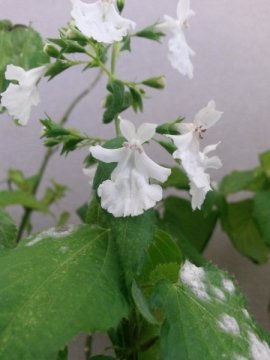
The plant, Phyllostegia kaalaensis, is in the mint family and only grew in the Waianae mountain range in West Oahu. It is listed as critically-endangered, and from 2002 until now, has only existed in two greenhouses on O’ahu, one managed by the State of Hawai’i and one by the U.S. Army. The major threats to its survival in the wild are habitat loss, invasive animals like pigs and rats, and diseases. In fact, one powdery mildew fungus does so much damage to these fragile plants that, even in a greenhouse, they require monthly fungicide treatments.
One problem with this fungicide-dependence is that plants aren’t so different from humans or other animals – when it comes to their health, every plant and animal depends on a collection of beneficial micro-organisms. In plants, the microbes that live in their leaves, stems, and roots, are called endophytes, and “good” fungi make up an important part of this consortium. Endophytic fungi are known to help plants survive droughts, obtain nutrients and minerals, as well as fight off infections. In fact, some of our antibiotics and cancer drugs derive from these endophytes. But when plants are sprayed with fungicides in a greenhouse, it doesn’t just kill the fungal diseases, it also kills the beneficial endophytes.

 Kihaku-Gato's Garden Blog (tumblr import)