

Broader leaves and taller form than starry false solomon’s seal; its just old joe known as False Slomon’s Seal (Maianthemum racemosum) w/o the starry in the name.
Sometimes… common names… are redundant.
Broader leaves and taller form than starry false solomon’s seal; its just old joe known as False Slomon’s Seal (Maianthemum racemosum) w/o the starry in the name.
Sometimes… common names… are redundant.
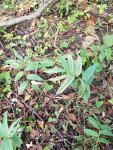
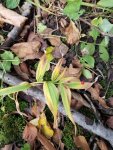
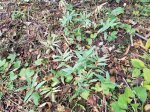
A cute little colony of Starry False Solomons Seal (Maianthemum stellatum).
Appears I had just missed their fruiting season.
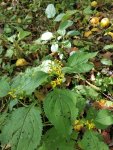
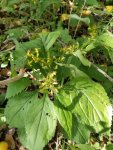

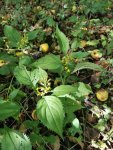
I called this Woodland Goldenrod in my tweets but that’s actually the wrong common name for this species (though I was correct for its habitat preference); they’re in fact Zigzag/broadleaf goldenrod (Solidago flexicaulis).
Short stature, broad toothy leaves, and small clusters of yellow flowers, it is almost a day-and-night comparison to the field goldenrods that thrive away from the forests.
This is actually the first time I’ve seen this species in the local woodlands, but at the same time I am almost never in the woodlands in the autumn season, so that’s likely in play. Granted, I only saw 2 different clumps of it in my entire forest walk.
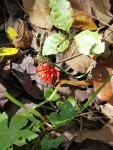
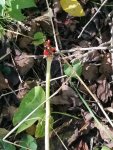
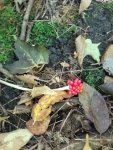
Wild Jacks (Arisaema triphyllum)
Looks like the wildlife are gleaning off some of their berries. My garden ones (fortunately) never get eaten by wildlife. With the bumbercrop at home I left the forest’s Jacks be.

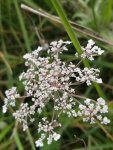
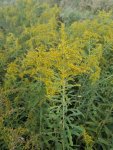
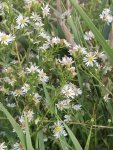
The sunnier side of the creek (as well as the untouched large meadow which I tragically did not photograph) had a lot of the standard wildflowers; New England Aster, Poison Hemlock (? I was gonna ID as wild carrot but then went “wait a minute wild carrots don’t like wet habitats”), Goldenrod, and white wild aster.

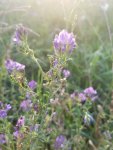
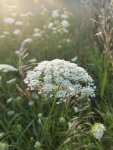

Road/ditchside wildflowers as the sun set.
I feel pain for anyone who has to ID Trilliums for a living though. Many of them can look so damn similar, google tends to overlap images for different species as if they’re identical so you’re out of luck using that as a reference, and without context of natural geography along with other visual details you’re pretty much screwed over unless you know very very subtle anatomical details (if you’re lucky you get very obvious details like the colour of the ovum before v after pollination, but even that can only get you so far).
Take “White Trillium” for example; Most of you upon hearing that name probably imagined Trillium grandiflorum. However, counting that species there are actually at least 15 kinds of white trillium. 2 of which are Sessile form, 4 of which are Asian species (yes Asia has a small select set of Trillium species). Not going to share images cause as I said, google isn’t dependable for all of them but among the species of white trillium there are (*sound of me turning the pages of my old Trilliums book before I begin*);
Among non-sessile NA species
Among sessile NA species
Among Asian species
Some genera like Trillium can be so goddamn messy augh I haven’t even included hybrids and stuff. It’s nonetheless amazing.
 Kihaku-Gato's Garden Blog (tumblr import)