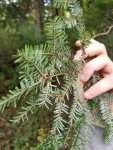
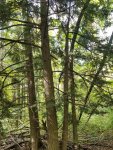
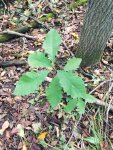
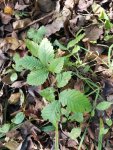
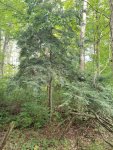
There were a LOT of Canadian Hemlock (Tsuga canadensis); old trees, young trees, one even uprooted but still holding on (will have a separate post for those two specific groups).

I’m sure there are at least 15+ specimens in that forest. I have never seen this many Canadian Hemlock trees in the wild before! All other specimens I’ve seen in the past have been either garden specimens (like in Cuddy Gardens) or were singular lonely specimens in the entire forest (that one swam forest walk a few years back).

It’s…. almost strange to think this tree is threatened by pests down south in the Appalachia.

4 Spring flowering tree gijinka design concepts/ideas

Cause art is frustrating and CAUSE WORDS WILL DO

Magnolia– largest/tallest/oldest of the four. Good charmer with birds (especially berry-eating birds). Leather/thick fabric petal dress. Very kind Oujo-sama/royal kind of air, despite this occasionally you’ll get these hints of a wild (almost witch-like) side, like she’s seen/been before the time of her christening as a royal. She knows a far more ancient time.

Cercis (aka. Redbed)- Heart-motif dainty tomboy (odd combo I know). Speedy/sporty despite the misfortune of injuring herself a lot due to said speed. Bees REALLY like her, no I don’t just mean honeybees, BEES REALLY LIKE HER, she would probably love leafcutter bees. I imagine she’d wear suspenders.

Malus (aka. Apple)- Country hick. Phyiscally stouter/rounder than the other 3. Wild curly hair that gets so annoyingly tangled when it gets long that she has to cut it a lot. Pink/red/white Plaid, probably a dress or apron. Motherlyish. Probably thinks you should eat more. She finds bees cute and spiders chill but she is terrified of caterpillars. Oriole birds like her.

Asimina (aka. Pawpaw)- tall but not as tall/built as Magnolia, is probably quite lanky. Green with hints of maroon-red clothes that are quite simple/practical and also full of pockets. Shy/aloof compared to the other 3. Probably lives in a woodland cottage. Despite her dark skin she burns from the sun easily. She doesn’t insist/advertise on people eating her baking as Malus does, but her baking has a taste that Malus sometimes gets jealous of and wonders why tf Asmina doesn’t show off her food more.

THEY LIIIIIIIIIIVE.

Most of the liveliest of the greenhouse residents right now. (not listed in order of the pics) Betula

alleghaniensis, Betula

populifolia, Thuja occidentalis, Catalpa sp., Picea glauca, Geum triflorum, Clemtatis tangutica, and Penstemon hirsutus.

These guys are also on the list of “gonna see if I can sell them this year” crops. Especially the Birches, cause they big and they are a pain in my butt lmao.

Photographed May 13th 2018

The Sugar Maple (Acer saccharum) that are under lights rn are survivors of the starving birds and mice (during that spring snow out we had a few weeks ago) that were scavenging the tray in the greenhouse. So, we see why these trees are so expensive; it’s not just that they grow slow as balls, it’s the fact that even at seed/seedling stage EVERY FUCKING THING WANTS TO EAT THEM. It’s not just us humans who find Sugar Maple deliciously enticing.

However due to the fact that autumn 2017 I had a lot of sugar maple seeds on hand thanks to our neighbour John, I had a lot of seedtrays of them, and consequently experimented stratifying them in different locations. One of said locations being the new experimental outdoor seedbed. It flooded and had severe freeze/thaw late winter / early spring so I thought pretty much every seed would’ve croaked. However as you can see here not only are they doing splendidly but the birds/mice couldn’t get their grubby mouths into them.

So to the Birds/mice that were total dicks to one of my most valuable future plant crops;

Photographed May 13th 2018

Reminder to Ontario Canadians that despite the snow, now (March-April, this year April due to weather) is a good time to get to pruning. While pruning isn’t always needed, it’s a good way to maintain the health and performance of your woody flora when the opportunity is available. Also remember; save for specific rare cases (or very vigorous species), ideally only take off 1/3rd of the living growth of your woodies (it does not hurt to get rid of the deadwood first to make this easier to measure). Also trees like old apple trees may respond to their first-ever prunings with bad watersprouts, so be ready for more pruning in the next year as you get them in shape.

And this shouldn’t need to be said but ALSO NO CHAINSAWS OR CRUSH PRUNERS IF YOU WANT GOOD HEALTH IN YOUR PLANTS FFS

Badly photoshopped (or technically fireaplaca’d but w/e) ideas/brainstorms for my now empty canvas of a shadowbox (cleaning it out of gross jarred insects was so overdue). Thinking fruitiforms to make most of the space while following a botanical theme. In order with pros/cons of each organizational idea;

Picea (Spruce) Species

  • Pros– Very easy to acquire said fruitiforms. Very clean and easy to dry.
  • Cons– Least decorative/interesting, the majority of Picea save for P. abies cones are very small so detract from such a large shadowbox display without adding multiples to balance it out.

Pinus (Pine) Species

  • Pros– Moderately to very decorative, moderately easy to acquire.
  • Cons– Very few species acquirable in the locality outside of P. sylvesteris, P. nigra, and P. strobus (last being actually moderately tricky to acquire intact cones of though trees are common) so not a lot of variety for the display. P. strobus cones while decorative are also quite messy. Most Pinus species’ open cones are much too wide to easily fit into the box.

Magnolia Species

Pros– Very variable fruitiforms making for a very unique/exotic display. The rarity of such of a display of species would be worth getting smug about.

Cons– Difficult to acquire (majority only accessible via distant arboretums & botanical gardens). Depending on species the fleshiness of fruitiforms (M. macrophylla in particular) may be very difficult to dry. Seeds which could make the display even prettier both difficult to dry as well as too valuable to leave in a shadowbox when they could be cleaned/sown instead.

Mixed Species

  • Pros– Can cherry pick for most decorative/dryable species of each group.
  • Cons– Thematically chaotic/miscellaneous in a negative way. This is a bigger deal to me than it sounds.

Taking a pretty strong lean on having a Magnolia/Pine based display. What do you guys think? Anyone leaning to one of these themes more than others or do any of you have ideas for an entirely different fruitiform/herbaria theme for such a shadowbox?

Pair of ‘mouse control technicians’ to lose their jobs when Ontario closes tree seed plant

“Pepper and Sammy are paid by the taxpayers of Ontario in room, board and veterinary care. These “mice-control technicians,” as one bureaucrat called them, are the reason there is no rodent problem at the Ontario Tree Seed Plant in Angus, Ont., about 120 kilometres north of Toronto. 

The cats are soon to be fired, however. The government will shutter the plant next September. 

The chorus of critics attacking the decision is not so much about the cats as the future viability of native species of Ontario trees.”

Pair of ‘mouse control technicians’ to lose their jobs when Ontario closes tree seed plant