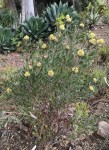
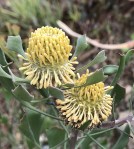
Isopogon trilobus
Though perhaps not as well known as some other groups in the Protea Family, Isopogon has many attractive shrubs, including Isopogon trilobus. Like all plants in the genus, it comes from Australia, which is home to many Protea relatives (though not plants in the genus Protea itself). Isopogon trilobus grows in rocky coastal sites along Western Australia’s southern coast.
-Brian
Tag: ruthbancroftgarden
Centaurea cineraria
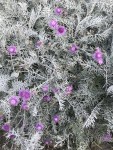
Centaurea cineraria (often found under the name Centaurea gymnocarpa in the nursery trade) is one of several plants called “Dusty Miller” because their white leaves look like they had been dusted with flour. While Centaurea cineraria comes from the Italian mainland, its relative C. gymnocarpa comes from the island of Capraia off the coast, and the latter name has somehow become identified with plants of the former. In any case, the white foliage and purple flowers make for a dramatic display. It belongs to the Daisy Family (Asteraceae).
-Brian
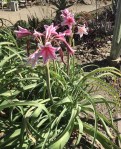
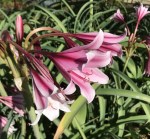
Crinum bulbispermum
The genus Crinum, in the Amaryllis Family, is widely distributed from Africa to the Pacific. Crinum bulbispermum is one of the African species, native to South Africa, Lesotho and Swaziland. Its long narrow leaves curl outward, and it has multiple bouts of flowering in late spring and summer. It takes its name from its very large seeds, which look like small bulbs. Although often found in wet places, it has fairly good drought tolerance.
-Brian
Salvia ‘Calamity Jane’
This salvia hybrid is the result of a cross between 2 species native to California’s Coast Ranges and southward into Baja California – Salvia mellifera and Salvia leucophylla. It flowers in late winter to spring, with whorls of lavender-blue flowers at intervals along the stalk. Quite drought-tolerant.
-Brian
Banksia nivea (Dryandra nivea)
This plant was first named as Banksia nivea, then transferred to the genus Dryandra. Now all of the species in Dryandra have been put back into Banksia, so it has regained its original name. It belongs to the Protea Family (Proteaceae), and has a wide distribution in the southwest corner of Australia, where it is referred to by the common name of “Honeypot Dryandra”. Its long serrated leaves make a delightful texture in the garden.
-Brian
Turbinicarpus pseudomacrochele
Turbinicarpus pseudomacrochele is a delightful dwarf cactus is native to the states of Queretaro and Hidalgo in east-central Mexico. Because of their small size and the way they are found nestled in rocks, these plants are very hard to find in nature.
-Brian
Gastrolobium celsianum
The common name for Gastrolobium celsianum is “Swan River Pea”, and as the name implies it belongs to the Pea Family (Fabaceae). It is a low-growing shrub which spreads horizontally, and it comes from Western Australia.
-Brian
Chamelaucium ‘MB Violet’
Chamelaucium is a genus of shrubs native to Western Australia. They belong to the Myrtle Family (Myrtaceae) and are related to Leptospermum (commonly called tea-trees, though they are not the source of tea). This one is a hybrid named ‘MB Violet’, with petals that are deep purple at the tips fading to white at the base. The flowers are very long-lasting as well as showy.
-Brian
Ruschia karooica
Ruschia is one of the larger genera in the Ice Plant Family (Aizoaceae), but not very many of the species are available in nurseries. This one is Ruschia karooica, from the southern Great Karoo, near Laingsburg, South Africa. Unlike some of the other kinds with a spreading habit, this one has more upright growth and forms a small shrub to 30 cm (1 foot) tall. It bursts into bloom in mid-winter, covering itself in flowers, but the show only lasts for a couple of weeks.
-Brian
Aloinopsis rubrolineata
Aloinopsis is a genus of small clumping plants in the Ice Plant Family (Aizoaceae), native to the interior of South Africa, where summers are hot and winters are cold. This one is Aloinopsis rubrolineata, from near Graaff-Reinet, in the southeastern part of the Great Karoo. The name of the species alludes to the red lines running down the middle of each petal. Besides the red line, the petals are always pale, with hues ranging from pale yellow to pale salmon-pink. Though it gets most of its precipitation in summer, it can be grown in places with winter rainfall if provided with sharp drainage and an occasional drink during the summer months.
-Brian