Hesperaloe tenuifolia
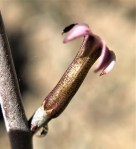
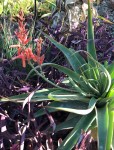
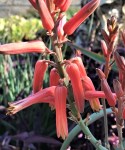
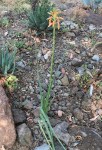
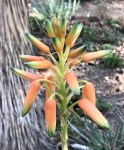
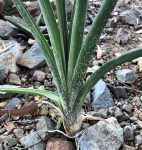
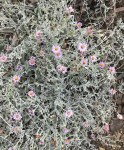
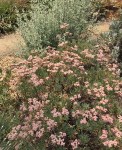
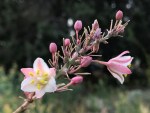
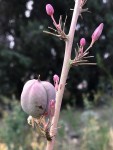
Hesperaloe is a small genus related to the yuccas, with all of the species found in northern Mexico or across the border into the southern United States. This one is Hesperaloe tenuifolia, with a very restricted range in southern Sonora State, in northwestern Mexico. It forms a small clump of narrow grassy leaves with tall inflorescences bearing bell-shaped pink flowers. It puts out flowers a few at a time over a long period in the summer and autumn months. The seed pods, seen in the lower photo, are rounded with a hard beak-like tip.
-Brian
Tag: ruthbancroftgarden
Adromischus triflorus
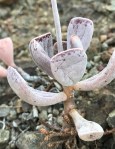
Adromischus is a genus of small plants in the Crassula Family native to southern Africa. Like other species in the genus, Adromischus triflorus has small tubular flowers and leaves with reddish spots or blotches. The form pictured has flowers more purplish than usual, with extra-pale leaves. From South Africa’s Little Karoo region.
-Brian
Aloe pulcherrima
This attractive Aloe species comes from the mountains of central Ethiopia. Its blue-green flexible leaves are almost toothless and taper to a slender point. The coral flowers emerge in the latter part of summer.
-Brian

Berberis (Mahonia) fremontii
Some botanists put the mahonias into the genus Berberis, while others keep them as a separate genus. In any case, they are shrubs notable for their prickly leaves, yellow flowers and attractive fruits. In the case of Berberis fremontii, the fruits vary in color from yellow to purplish-red. Native to the southwestern U.S. and northern Mexico.
-Brian
Aloe cooperi
Aloe cooperi is one of the “grass aloes”, which have long narrow leaves and grow in grasslands. It is native to the eastern part of South Africa, in KwaZulu-Natal and northward into Mpumalanga. The coral or orange flowers (with green tips) emerge in summer. The leaves are strongly channeled and have a peppering of white spots at the base.
-Brian
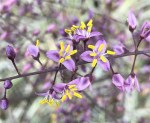
Lessingia filaginifolia
This member of the Daisy Family is native to California, and also northward into Oregon and southward into Baja California. It remains quite short, and spreads laterally as a ground-cover. It has attractive gray felted leaves and lavender flowers with a yellow eye.
-Brian
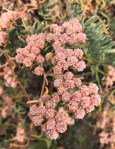
Eriogonum arborescens
The eriogonums, popularly called “buckwheat”, are very abundant in California. This one is Eriogonum arborescens, native to southern California’s Channel Islands. It makes a handsome drought-tolerant shrub, with dark branches and finger-like blue-green leaves. Like other members of its genus, it has clusters of tiny flowers during the warm months of the year, and in this species they are pink, contrasting nicely with the bluish foliage.
-Brian
Hechtia tillandsioides
Hechtias belong to the Bromeliad Family, and in most cases they have sharp teeth along the leaf edges, but Hechtia tillansioides looks more like the non-toothy tillandsias (from which it takes its name). It actually does have tiny teeth, but close inspection is required to even notice them. While most hechtias have white flowers, H. tillandsioides stands out with its lavender-purple blossoms. There are separate male and female plants, and the yellow pollen visible in the photo above shows that our plant is a male. From south-central Mexico, in the states of Hidalgo and Mexico.
-Brian
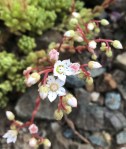
Sedum hirsutum
This little ground-cover has sticky-hairy yellowish-green leaves and is native to southwestern Europe and northwestern Africa. When it flowers, the reddish stalks and snow-white petals add a nice touch, with the black-tipped stamens looking like flecks of black pepper against the white of the petals. Sedum belongs to the Stonecrop Family (Crassulaceae).
-Brian
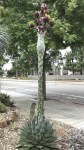
Agave montana
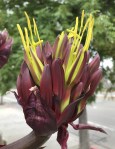
Agave montana is native to a few mountainous areas in northeastern Mexico, and until recently it was seldom seen in gardens. The plant pictured is the first time we have had it come into bloom at the Ruth Bancroft Garden, and it is a striking sight with its dark-purple floral branches and bracts, its dark red buds, and the vivid yellow of its stamens, pistils, and the insides of the flowers. With its compact artichoke-like rosettes of leaves and its considerable cold-tolerance, this is a species well worth seeking out. Unlike many other agaves, it stays single rather than putting out offsets with abandon.
-Brian