ruthbancroftgarden:

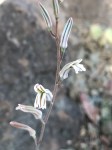
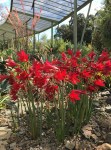
Rhodophiala bifida

This beautiful bulb belongs to the Amaryllis Family, and is native to Uruguay and Argentina. This is an area which receives year-round rainfall, so it is surprising that it goes dormant in the summer (much like bulbs from dry-summer Mediterranean climates). This is simply a means of waiting out the heat of the summer months, and its roots still appreciate a little water during the summer. At the end of the summer, it bursts into bloom just before the new leaves emerge.

-Brian
ruthbancroftgarden:

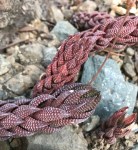
Haworthiopsis coarctata var. tenuis

This plant was formerly in the genus Haworthia, but the group it belongs to (which was called subgenus Hexangulares) has been elevated to the level of a genus. The plants in this group generally have firmer leaves than most haworthias, and this includes the ones which stack up to form columns – like H. coarctata. Haworthiopsis coarctata var. tenuis is more slender than other forms of the species, and it tends to color up nicely, taking on purplish-red tones. At one time, this plant was considered to be a form of H. reinwardtii, which is closely related to H. coarctata, but authority Bruce Bayer says it belongs in H. coarctata. It comes from near Grahamstown in South Africa’s Eastern Cape Province.

-Brian

ruthbancroftgarden:

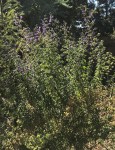
Trichostema ‘Midnight Magic’

The genus Trichostema is a small group of shrubby plants in the Mint Family (Lamiaceae) native to North America. This one is a hybrid between Trichostema lanatum (native to California and Baja California, and commonly called “wooly blue-curls”) and T. purpusii (from Mexico). Its purple flowers last all through the warm months of the year, often continuing well into the winter.

-Brian

ruthbancroftgarden:

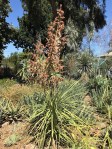
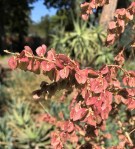
Beaucarnea recurvata x stricta

Beaucarneas are often referred to as “pony-tail palms” and grown as house plants, but out in the ground they can become very large in time, with the swollen base too large to wrap one’s arms around. They have separate male and female plants, though these cannot be told apart until they reach flowering size. For landscaping appeal, the females are superior because they provide color over a much longer period while the seeds develop. In contrast, the male flower stalks turn straw-colored and wither after the flowering finishes. The color of the stalk and the seed pods on females is variable, and ranges from slightly red-tinged to quite red. The plant pictured is a hybrid between B. recurvata and B. stricta, both native to Mexico. This is its first flowering, so now we know that it is a female. Beaucarnea belongs the family Nolinaceae (or alternatively, the tribe Nolinoideae within the Asparagus Family).

-Brian

ruthbancroftgarden:

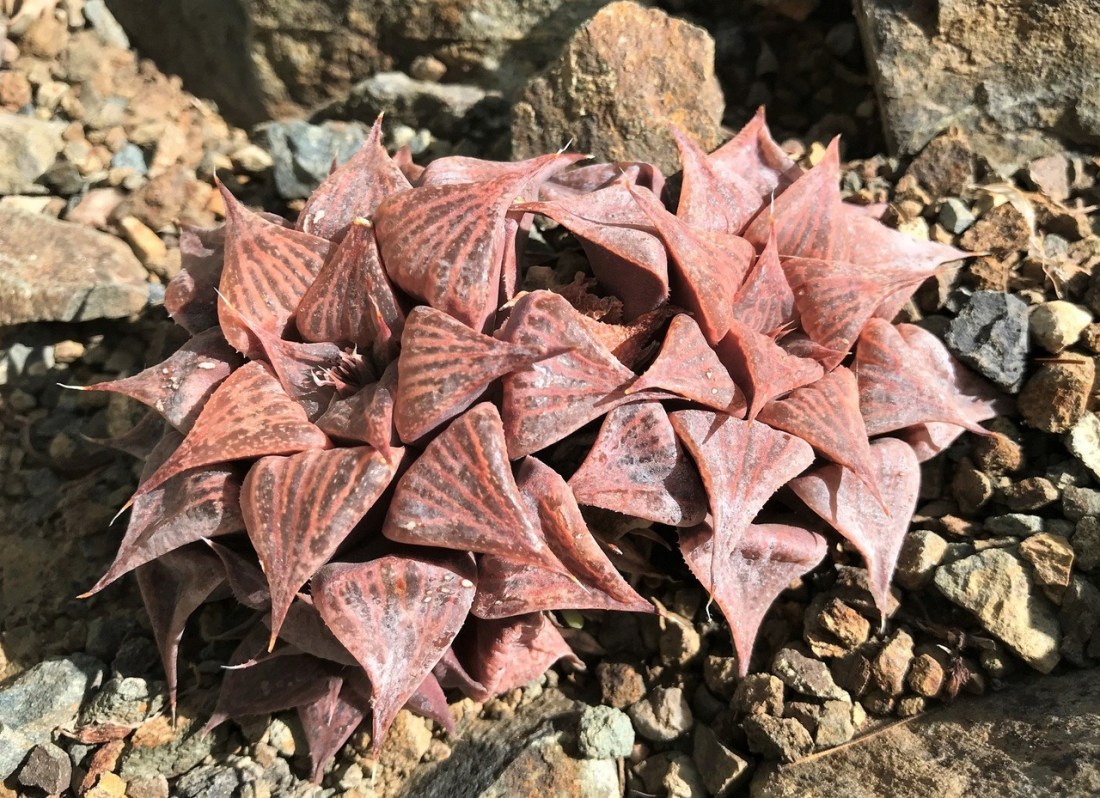
Haworthia magnifica var. acuminata

This is one of the “retuse haworthias”, whose triangular leaf tips have translucent “windows” to let the light in so that it can reach the photosynthetic tissue on the lower part of the leaf from the inside. Our plant is looking especially colorful this year. The genus Haworthia is related to Aloe, but they are small plants with inconspicuous flowers (their appeal to collectors is centered on their attractive rosettes of leaves). Haworthia magnifica var. acuminata (formerly classified as H. retusa var. acuminata) is native to the lower Gouritz River, to the west of Mossel Bay, South Africa.

-Brian

ruthbancroftgarden:

Adromischus triflorus

Adromischus is a genus of diminutive plants in the Stonecrop Family (Crassulaceae), mostly found in South Africa. Their flowers are charming, but they only open a few at a time and are small enough that it is easy to miss them. More evident are their endlessly variable chubby leaves, often with attractive purple spotting. Adromischus triflorus comes from South Africa’s Little Karoo region, and its spatulate leaves vary considerably from one population to the next in their width and degree of spotting. The plant pictured is only a couple of inches tall (5 cm), and has leaves which are narrower, less spotted and more whitened than other forms of the species. The flower color in A. triflorus ranges from white to pink- or purple-tinged, and ours is at the purple end of the spectrum.

-Brian

ruthbancroftgarden:

Aloe harlana

This species takes its name from the tiny village of Harla, close to Dire Dawa in northeastern Ethiopia. Plants in cultivation tend to have red flowers as seen here (a darker dusky red at the bud stage, and a brighter red with some orange at the mouth once the flower has opened), but plants in habitat may be yellow as well. The glossy leaves with nice spotting are reminiscent of relatives such as Aloe jucunda and Aloe hemmingii, but A. harlana is a much larger plant with its flowers more clustered at the ends of the floral branches.

-Brian

ruthbancroftgarden:

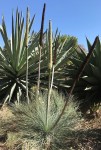
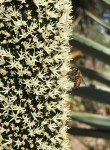
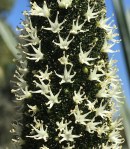
Xanthorrhoea quadrangulata

The various species of Xanthorrhoea are commonly called “grass trees” because of their narrow grass-like foliage. They are slow-growing  plants from Australia, but some of them eventually develop a trunk, so this accounts for the “tree” part of the name. At the Ruth Bancroft Garden we have 3 species of Xanthorrhoea, and X. quadrangulata is the only one which flowers in the late summer to early autumn. The flower stalks look like giant pipe-cleaners, and the upper part which bears the flowers is initially a glistening deep green. Then the flowers start to emerge like tiny white stars (first just a few, and then many as they get going). Bees are attracted to the flowers, and one can be seen visiting in the middle photo. This plant is native to the state of South Australia, near Adelaide and Port Augusta.

-Brian

ruthbancroftgarden:

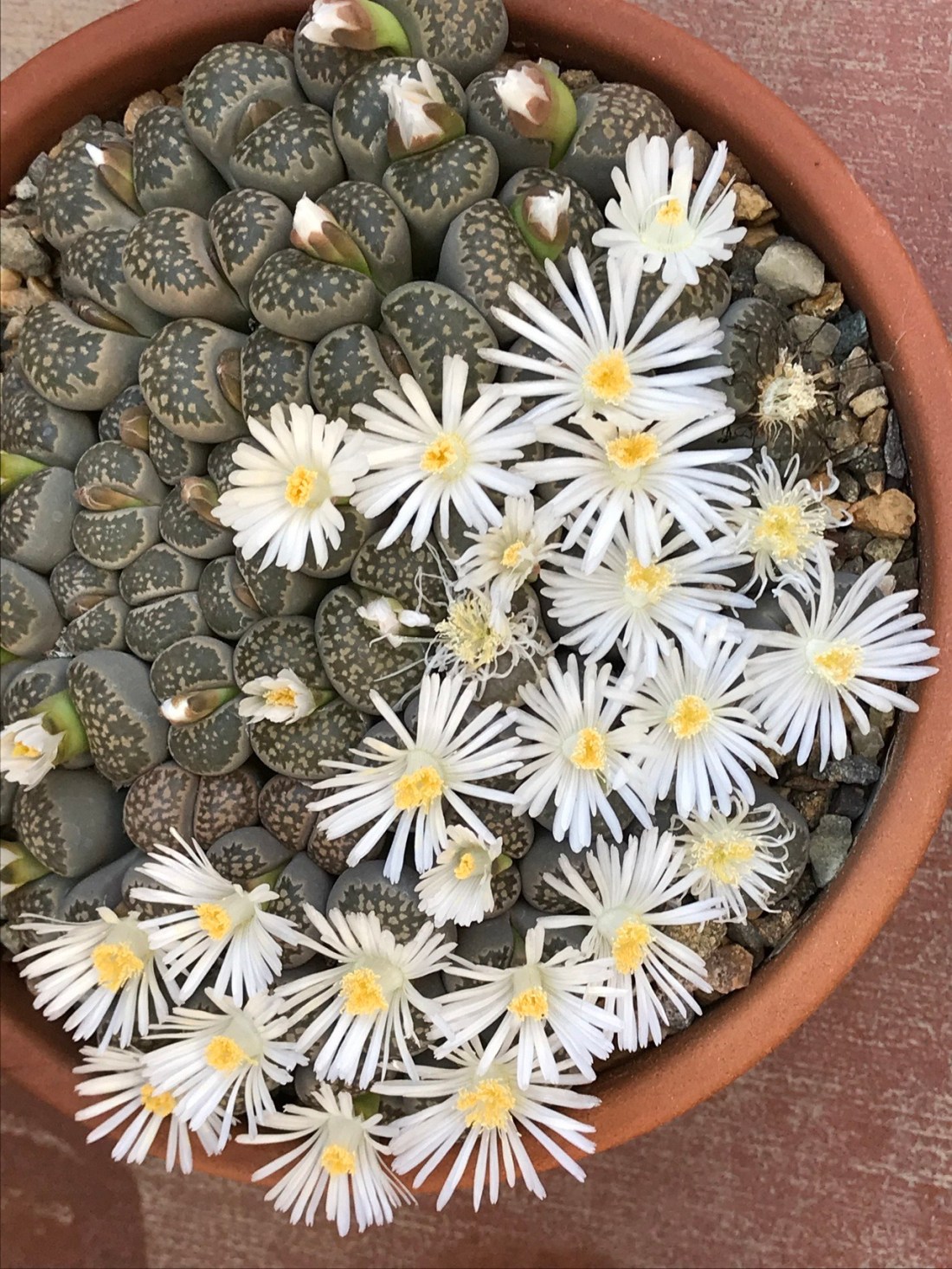
Lithops salicola (maculate form)

Lithops is a large genus in the Ice Plant Family (Aizoaceae), all native to southern Africa. These plants are often called “living stones”, and indeed they do blend right in with the pebbles in the places where they grow. But they put on an eye-popping show when they burst into bloom, as seen here with the maculate (speckled) form of Lithops salicola, which comes from near Hopetown in South Africa’s Northern Cape Province. This is very near to the center of the country.

-Brian