
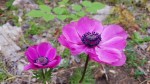
V loves anemones. I quite like them myself, these are actually my favorite type. They are technically only hardy to zone 7, not 6. Every year I try to add more to the garden.
These are in the bed at the bottom of the driveway, which consists mostly of logs and plants shoved in between. It was constructed in a hurry. The top picture also contains a ‘George Tabor’ Azalea, which is the azalea of my childhood so when we got this place I HAD to have them.. it is also only hardy to zone 7, so it hasn’t done well here. This is not entirely my fault, all the maps say that we actually are zone 7, so I bought these before we figured out that we are mostly zone 6, with some parts in zone 5.
They rarely bloom. Also being planted in a tiny amount of soil and a bunch of logs has probably not helped. They may also be blasted by the cold… cold moves down mountains like slow water, and these are on the front lines. There are azaleas that look similar to these that are definitely hardy here – there’s at least one Encore Azalea that almost looks like it – but it’s just not the same.
Despite being exhausted I really really really want to go out and work in the garden. It is so beautiful! There’s so much to do and see! V said I can use all the mulch I want from the giant mulch pile as long as I move it myself!!!!!!! Shit y’all I’ve got work to do. There’s not much point getting weeds out of something until I either have plants to replace it with, or a thick layer of mulch, and now we have a lot of mulch on hand. It’s go time, despite the July-like weather we’re having.
My body has taught me though, that if I work 5 days in a row at the plant nursery I have to rest on the 6th. Hence me sitting down to type this out.
The dead looking stuff is a perennial I let go to seed… spread my friends, spread. Also pictured is some clary sage foliage covered in soil, b/c I was on an evening weeding rampage.
We planted the Asian pear (Shinko+BET) I successfully grafted in the new berm which doesn’t have a name yet. The foliage is dirty but not diseased, btw. The ugly yellow stuff at the bottom was how I kept track that it was one that I had done. V is a grafting machine so he did tons more while I carefully – and with great terror – struggled with the sharp box cutter.
It is next to the Mystery Apple tree.
We also planted the organic blue potatoes I got from work, and we made a large container and filled it with some cheap bulbs I picked up from Aldi’s – a Dahlia ‘’Vancouver’ and a big mix of glads. The whole thing is topped off with some mystery brassicas from work, but they might be ‘Green Giant’ hybrid Broccolis, or at least I fervently hope so.
My begonia has succumbed to that fungal disease that they get. V told me this happened to the last one I brought home, which I absolutely do not remember, but I’m not surprised b/c it’s a plant I freaking love (Rex ‘Escargot’). Anyway I’ve been battling it on some plants at work, and the one I bought and brought home was from that same batch. Notably, this is the first time at work I’ve battled with it, so I just so happened to buy from the bad batch, before it was obvious that there was a problem. Ugh!
The neem oil does nothing, but I’m not about to pull out the serious fungal sprays for it.
I think this tree really likes to bear heavily every other year for us. Some years it produces monster harvests and other years are like this one. That, or being absentminded has downsides when it comes to this plant. I have been battling spider mites on it with neem oil, but honestly the neem doesn’t seem to be doing much so I might try some highly diluted Dr. Bronners (aka cheap phosphate fatty acid soap). What it really wants is to be outside on the porch, but we keep having crazy weather (more snow! high winds!) so for now it is here inside.
I feel so much safer in these mountains. Full of nooks and crannies and excellent hiding places. Flat open spaces have always made me feel uncomfortable, in a hind brain sort of way.
Once upon a time, this was all old growth forest. It has been logged, most likely multiple times. Still, the trees persist and do their best, despite the relentless tendency of humans to murder trees on an insane rate around the globe.
The use of scrap tire chips for landscaping has become controversial, due to the leaching of metals and other contaminants from the tire pieces. Zinc is concentrated (up to 2% by weight) to levels high enough to be highly toxic to aquatic life and plants.[88] Of particular concern is evidence that some of the compounds that leach from tires into water, contain hormone disruptors and cause liver lesions.[89]
Tires are dirty, drive on dirty roads, and then leach out nasty stuff.
“
Part of the toxic nature of rubber leachate is due to its mineral content: aluminum, cadmium, chromium,
copper, iron, magnesium, manganese, molybdenum, selenium, sulfur, and zinc have all been identified in
laboratory and field leachates. If rubber products have been exposed to contaminants during their useful
lifetime, such as lead or other heavy metals, they will adsorb these metals and release them as well. Of
these minerals, rubber contains very high levels of zinc – as much as 2% of the tire mass. A number of
plant species, including landscape materials, have been shown to accumulate abnormally high levels of
zinc sometimes to the point of death. One USDA researcher who has studied zinc and other metals in
soils and plant materials for decades strongly believes that ground rubber should not be used “in any
composting, or in any potting medium, or casually dispersed on agricultural or garden soils” because of
zinc toxicity. Acidic soils and aquatic systems are particularly sensitive, since heavy metals and other
positively charged elements are less tightly bound to the soil and more available to plant and animal
uptake.
Rubber leachates are complex solutions. They include not only the minerals and organic building blocks
of rubber, but also various plasticizers and accelerators used during the vulcanizing process. In high
enough concentrations, some of these rubber leachates are known to be harmful to human health; effects
of exposure range from skin and eye irritation to major organ damage and even death. Long term
exposure can lead to neurological damage, carcinogenesis, and mutagenesis.
Some of these materials break down quickly, while others are known to bioaccumulate. One of the more
common rubber leachates is 2-mercaptobenzothiazole, a common accelerator for rubber vulcanization. In
addition to its known human health concerns, it is highly persistent in the environment and very toxic to
aquatic organisms: its environmental persistence may cause long-term damage to aquatic environments
constantly exposed to rubber leachates. Another family of organic leachates under scrutiny are the
polyaromatic hydrocarbons (PAHs). These compounds, used as rubber softeners and fillers, have been
repeatedly demonstrated to be toxic to aquatic life. PAHs are released continually into solution, and after
two years in a laboratory test leachates were shown to be even more toxic than at the study’s inception.
Daffodils!! Behind them are a ‘Reliance’ grape vine and a ‘Seedless Concord’ grape vine. The grape vines are against a rustic pole made of Black Locust, and is part of our Unusual Trellis Situation.
It has been warm and wet, which is GREAT weather for weeding and generally clean out some beds. There’s lots more mulch to haul down and my old nemesis grass continues to be a problem, but that’s life in a garden.
Location: the edge of V’s original Elderberry bed / berm / terrace / hugelwhatever.
Spartacus looks jet black, except when he’s in the sunlight, and becomes dark, dark brown. Possibly the most brilliant and quirkiest cat I’ve ever known. He is a heavy sleeper, even then, I’m rarely able to get this close before he wakes. The sunny edge of the futon is his favorite place; the cats have generally claimed the futon for themselves.
On the right is part of our mess of indoor plants. Spartacus loves to climb into the large pot that the Ficus lyrata is in, and to lounge and generally make messes. He is spastic and messy, and – based on how the other cats interact with him – he is very socially awkward.
Also visible:
branch of a tropical hibiscus, which looks much better than the rest of the larger, braided tropical hibiscus
night blooming cereus
aloe plant gone wild
Just out of sight: the Christmas tree, which I’m not sure when to take down. I’m convinced I haven’t fully appreciated it, and will miss it during the rough month of February. Yet, I might be over it??
( If you tag your stuff like ‘plant’ and ‘art’ or something then people can more easily filter out but stay subscribed. )
True but I’m a low energy lazybody. I surprisingly have to take a lot of effort sometimes to use my most base of tags. For a while I did “offtopic” as an all encompassing tag for stuff that wasn’t plant related but that kind of got thrown out the window in 2017 purely out of losing track of it…
Not seen here is Rumi screaming at us when we went near the river. Here you can see once again him trying to herd me away from it, and then jumping on me and basically holding me down while purring. He is happy – we are safe.
He freaks out every time we get near the water.
He and Spartacus have divided up our property and they each patrol different sections. It is interesting to see what they consider to be our home, and what isn’t. Rumi also likes to patrol from the roof – he is fearless and does not mind heights.