32, 64, 82 for the plant questions!

32. Do you spend lots of money on plants? 

I have definitely spent a lot in the past. Probably about 2 years ago(?) I spent $80 on seeds. Surprise surprise not much of any of it germinated, severe regret ensued. I generally spend more if it is a plant sale or something quite rare (though I do have a price threshold). Icr my spending averages from my highschool days where I was much more spendy with my plant obsessions.

Nowadays I’m trying to spend on plants/seeds that I can enjoy while at the same time being stock plants to propagate to sell. It’s tricky since so many good varieties are patented nowadays (which I try to avoid like the plague with mixed results). Most of my money now goes for equipment (tools, soil, etc.) rather than actual plants.

64. Favourite roots?

Aesthetically? Taproots and Buttress roots, they’re the most dramatic imo. For practicality I’d say tubers (which technically are not roots but SHHH) like Hemerocallis tubers; easy to recognize in the garden and generally easy to transplant.

82. Do you give your plants names?

Not really no. I have referred to some plants by shortform pet names but not truly a name. Closest would be my transplanted Balloon flower which I keep referring to as KENNY!!! cause I thought it had died.

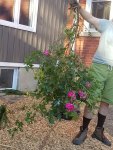
F*CKING MASSIVE ROSE

Ignore unhinged jaw of my face I wasn’t planning to be in the shot. Y’know when I said “the Canadian Explorer Rose will be the T-rex of the plant relocation/rescue project” I DIDN’T REALIZE HOW ON THE MARK I’D BE ON THAT DISTINCTION! She’s fucking HUGE! Also hellishly thorny just like grandma rugosa, I actually had to get my gloves out to be able to lug her up (I was stubborn about NOT getting the gloves till that point. Much yelping had ensued beforehand). A lot of her full size was concealed by the overgrowth of weeds where she resided. Such a contrast to the other hybrid rose (which is a Hybrid Tea) which barely reaches my knee, THIS rose could reach my waist+ if propped up. In Canada this size is not unusual for many species roses, but for a lovely hybrid rose this is something I am not the least bit used to, even after having this girl for as long as I’ve had.

Unfortunately as you may have noticed from the photos though; not a lot of roots came up with the rest of her, which is bad, really bad for such a monster (ESPECIALLY if one is transplanting in MID FREAKING SUMMER). So after these photos were taken I took to pruning two thirds of her (which may still not be a liberal enough of a prune-out) which should hopefully make up for lack of roots. I’m hoping her Rugosa background gives her the edge to take to the new flowerbeds (more on that another time) and bounce back, though that does not entirely keep my confidence as I have never had luck with transplanting Rugosas either.

Fingers crossed she makes it through the summer, but if not I at least know which group of Rose hybrids I will seek once again; Canadian Explorer roses all the way.

Photographed July 8th 2018

@allymaerusso replied to your post “botanyshitposts:
tumble dot hell is wild and i am So Weary so here’s…”

@kihaku-gato I’m confused why continuing to produce this species is necessarily a bad thing if the nurseries u say are propagating by seed, cutting, or grafting they’re able to reproduce the species and keep the rest in their natural habitat. Why not buy a bunch from a a nursery and just transplant them in their native region?

Producing a plant species in nurseries is not a bad thing. I meant that as in that is how it’s relieving pressure from the wild populations. That is a good thing (it’s part of why I myself am working on producing Jack-in-the-pulpit in my home nursery. It’s so that the demand to poach such a species drops, as poaching is becoming a thing in the more southerly counties of my region). I was meaning those who say appreciating a beautiful plants species MUST mean it’s being promoted to be poached are off the mark.

As for “buying nursery stock to reintroduce into the wild”, that is its own can of worms that I myself think would not be able to entirely elaborate on but I’ll try my best;

 There is a class of nursery production known as Landscape Restoration wherein the production of the plants is for the purpose of reintroducing/reestablishing into the wilds, this style of production works a little differently from normal nursery production; the plants to a degree are given a pedigree. One has to document where their parentage comes from; Where the seed/cuttings come from (often the info the nursery will provide will be either an ecoregion or an address). St. Williams Nursery in southern Ontario is an infamous example of a Landscape Restoration Nursery.

At its bare-bones landscape restoration nurseries work this way is for Genetic Diversity reasons. Let’s use Cucumber Magnolia for this format; it’s endangered in Ontario, but common/widespread in the eastern american states. Why grab Cucumber Magnolias from a Landscape Restoration nursery vs just any nursery to reintroduce them (who would care? who would know?)? Yet again pedigree comes into play; Non-landscape restorative nursuries can/could be american imports which are genetically distinct from Ontarian Magnolias, so you’re risking genetic pollution between the two, and american Magnolias are not as adapted to Ontario’s odd winters compared to Magnolias which have been growing for generations in this ecoregion, so you risk killing the remaining trees through that genetic pollution.

In the case of a species that is outright extinct in the wild, reintroduction is through nursery stock is less of a concern (still can be concerns but I don’t have much energy to elaborate on the varying factoids); you don’t need to worry as much about genetic pollution, just getting them established/naturalized. in the case of where a species is endangered not extinct, this is a bit trickier to decide (though similar questions arise even when reintroducing a plant which has become extinct); is the species being produced by the nursery for the purpose of reintroduction, or is it being produced with the primary intent of hobbyists/gardeners to grow the plant? The former the plants will be produced with the intent of maximizing genetic diversity to make them the most adaptable to reintroduction, the latter though the plants will be often bred the opposite direction (bred for conformity and genetic similarity, often via selective breeding or vegetative propagation) which means they deviate from their wild cousins; they bring with them the potential of polluting the adaptability of the existing wild populations (especially if the introduced plants outnumber the wild endangered specimens), bringing in weaknesses to diseases/pests that their wild equivalents are more resistant to vs their domestic introductions, they may even be bred in such a way that they cannot mesh with the ecosystem the same way due to the deviation from the wild species’ gene pool.

My eyes are overloading from the text so I’ll stop here. But in conclusion; 

TLDR; Nursery Production of plants is a good thing, however using nursery produced plants to reestablish wild/endangered populations of plants is not a good idea if that is not what the Nursery is growing the plants for. Reintroducing plants from the wild should be kept to the professionals and the volunteers that are with the professionals.

@botanyshitposts your Western Skunk Cabbage reblog post reminded me of the fact there are a couple of different plant Genera shared between Asia and North America; some which people expect or don’t expect.

Like

  • Trillium
  • Arisaema
  • Asarum
  • Gymnocladus
  • Paris
  • Lilium
  • Fraxinus
  • Acer

and probably a bunch of others just throwing the ones off the top of my head (both well known and not). The evidence that NA and Asia where once connected continentally via the botanical evidence is pretty neat.

Hardly a few days ago I attended the funeral of my late Aunt Joyce. It’s still somewhat a trip to fully awknowledge that she is now gone from this world.Especially in my younger years she was a large influence to part of who I am today. Outside of the usual monetary/candy gifts I more distinctly remember her gifting, if not passing down some of her old encyclopedic gardening/plant books (which I still have), at the time when I was book devourer I absorbed what I could like a sponge, she enabled the interest to the point I grew to seek it more and more.

At times I would hang out at Grandma’s where Joyce too resided, oftentimes they would both be tending to the closeby gardens if they weren’t just soaking up the outdoors on their chairs. It still awes me even now remembering their wrinkled frail hands unhesitantly working and tending to the roses, especially the oh-so-thornful Rugosas. Joyce one time even gifted me a break-off of beastly rugosas, which didn’t make it, but was what made me grow some interest to roses, especially rugosas back in my mind, despite the fact I had seen roses as nothing more than fickle brats to attend to in a garden setting, it was also what made me grow an obsession for Rugosas and their hybrids despite never growing any save for one Canadian Explorer Rose. I am sure out of the many flowers she loved, roses were definitely one of her most favourite. Other plants came from those gardens which I still have, particularly the Lily of the Valley, and Solomon’s Seal both of which still thrive in my own gardenbeds, almost overzealously so.

One plant that Grandma did not have that only Joyce had, and also introduced me to, was the Rose of Sharon. Rose in name only, she pruned them every spring, and gifted me some of many seedlings which naturally popped up from the cultivated soils. Until the barn fire of November I had a stately white rose of sharon for several years which was a child of her own, which charmed me to as how it charmed her.

I also remember how she would talk about how she and Elvey would use the old greenhouse on Grandma’s property to grow and sell Tomato plants. Even after those days the Greenhouse still prospered as a vacation spot for the large array of houseplants both Joyce and Grandma had. It’s funny to think that although I grow very different things from her, that I’m nonetheless still taking on a similarly Horticultural pursuit in my own life as a perennial/tree nursery grower with my own greenhouse.

She was an influence to many not just me. Nonetheless I will not forget what she had taught/gifted me. Rest in Peace Aunt Joyce, I am sure you would’ve been glad your funeral was on such a beautiful day with flowers blooming all around the churchyard and graveyard.

Dad probably wonders why I get so buckwild whenever he’s out mowing the lawn every time but like???? How can I NOT where do I even start on the oldest memories of losing plants to him. In the past he has (not in chronological order);

– Weedwacked several potted Rose of Sharon seedlings that were HIGH UP ON CHAIRS. The pots were ripped apart as much as the seedlings.

– Nearly mowed our only official female ginkgo tree sapling which was MARKED (and by nearly I mean “definitely drove close to it that he would’ve only realized he was by the fact the mower blades were hitting wood”)

– The time he almost set the ENTIRE QUARTER OF THE ORCHARD ON FIRE DESPITE US TELLING/SCOLDING HIM TO FUCKING STOP BURNING STUFF THERE. The ashpit it left in the grass/lawn for that area is still there despite it being over a year or two cause of how severe it fucking was.

– The fact said fire(s) have lead to HIS OWN spruce sapling to become halfway dead due to the severe heat/fire damage, and he IS CONFUSED AS TO WHY WE WANT TO REMOVE IT WHEN ITS SO SEVERELY DAMAGED AND AT THE FRONT OF THE PROPERTY.

– FUCKING DROVE OVER A GINKGO TREE TALLER THAN DAD HIMSELF WITH THE FUCKING TRAILER. WHEN THERE IS PLENTY OF FUCKING DRIVEWAY SPACE RIGHT BESIDE TO MISS EVEN IF YOU WERE DRIVING LIKE A DUMBASS.

And those are just the things I remember. There is probably a fair bit more my brain has catered to making me utterly completely forget (thank you for once brain).

So when I hear lawnmower and him in the same sentence when I not only have all my potted birch trees outside the greenhouse (they needed to be out of the greenhouse environment to give the pests a harder time) PLUS my potted Tangutica clematis in the morning before breakfast or even before I’m awake OF COURSE IM GONNA EXPLODE IN A RAGE-FILLED ANXIETY. I kill plants enough without having assistance with the ones that actually do ok for me!!!

Well the good news is that now I KNOW the shade cloth will do its job for the Jacks in the greenhouse this summer. The bad news is, that explains why the sun-loving lavenders haven’t been exhibiting their rich Mediterranean gray colour. Whoops.