There are only 46 hours to go until my book campaign is over! The book is now 117% backed, which is stupendous! You can still back the book and other rewards until it’s over!
As previously mentioned, once the books are made and sent out, remaining books will be put up on my Tictail shop for future sales 🙂 I’ll link to it when it’s up ^_^
HOLY SH*T. THEY FOUND NITROGEN-FIXING CORN BRED BY INDIGENOUS PEOPLE IN MEXICO. @botanyshitposts
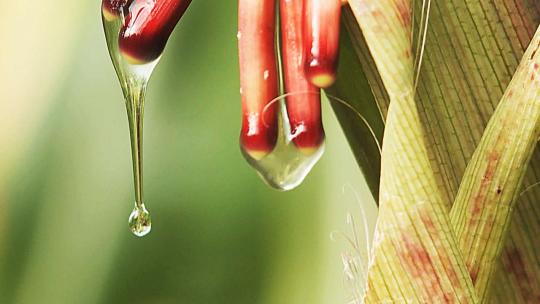
“The study found the Sierra Mixe corn obtains 28 to 82 percent of its nitrogen from the atmosphere. To do this, the corn grows a series of aerial roots. Unlike conventional corn, which has one or two groups of aerial roots near its base, the nitrogen-fixing corn develops eight to ten thick aerial roots that never touch the ground.
During certain times of the year, these roots secrete a gel-like substance, or mucilage. The mucilage provides the low-oxygen and sugar-rich environment required to attract bacteria that can transform nitrogen from the air into a form the corn can use.
“Our research has demonstrated that the mucilage found in this Sierra Mixe corn forms a key component of its nitrogen fixation,“ said co-author Jean-Michel Ané, professor of agronomy and bacteriology in the College of Agricultural and Life Sciences at UW–Madison. “We have shown this through growth of the plant both in Mexico and Wisconsin.”
…
“
Researchers are a long way from developing a similar nitrogen-fixing trait for commercial corn, but this is a first step to guide further research on that application. The discovery could lead to a reduction of fertilizer use for corn, one of the world’s major cereal crops. It takes 1 to 2 percent of the total global energy supply to produce fertilizer. The energy-intensive process is also responsible for 1 to 2 percent of global greenhouse gas emissions.
“
I’ve written about this before, this is one of those ‘saving the planet’ levels of discovery. No joke.
if you’ve been here any length of time you will recall that I’m usually the killjoy over here going “there are no silver bullets.” And this has a long way to go before it’s actually of use to farmers, but IF that happens (and that’s still a BIG IF) this would be a legit Big Fucking Deal.
Two things make me hopeful that this will not just disappear into corporate-owned varieties: one, this research was largely done through two land grant universities. Over decades. This is what land grant universities are FOR: their stated purpose is to do useful shit that’s too unprofitable for corporate R&D to care about. They are exactly the people you want developing awesome new ag tech. Mars, Inc. is involved with this too, and I trust them…not at all, but they’re not Monsanto, so it could be worse.
The other thing is this, from the linked article:
The municipal authority and community in the isolated village in the
Sierra Mixe region were an integral part of this research project.
Biological materials were accessed and utilized under an Access and
Benefit Sharing (ABS) Agreement with the community and with permission
from the Mexican government. An internationally recognized certificate
of compliance under the Nagoya Protocol has been issued for such
activities.
The ABS Agreement was structured under the terms of the Nagoya
Protocol on Access and Benefit Sharing, which is designed to ensure the
equitable sharing of benefits arising out of the utilization of genetic
resources and contributing to the conservation and sustainable use of
biodiversity.
I don’t know the details of the Nagoya Protocol. But at the very least, this isn’t outright theft of indigenous technology for corporate profit. Someone has at least thought through an equitable way for the community that developed this trait over centuries of growing maize to benefit from its use.
Finally: this is (one reason) why it’s important to preserve local crop varieties (also called landraces). Most industrialized agriculture is incredibly homogeneous genetically. It’s from the landraces that people developed slowly for specific conditions that we can find new traits–this is an extreme example, but it’s common to find landraces that are resistant to certain pests and diseases.
Oh and one more thing: Zea mays aka maize aka corn aka “indigenous Mesoamericans were better crop breeders than anyone alive today, apparently” is the WEIRDEST FUCKING PLANT, WHAT THE FUCK.
Nowadays, it’s difficult to get your works out there so this is a good way for me to be able to support myself (like eating regularly and paying bills…) while focusing on making my original works!
Since I’m working on those full-time now even $1 is greatly appreciated! But, of course, you can support me in other ways…like giving this a reblog ;w;
“Animal blood comes in a rainbow of hues because of the varying chemistry of the molecules it uses to carry oxygen. Humans use hemoglobin, whose iron content imparts a crimson color to our red blood cells. Octopuses, lobsters, and horseshoe crabs use hemocyanin, which has copper instead of iron, and is blue instead of red—that’s why these creatures bleed blue. Other related molecules are responsible for the violet blood of some marine worms, and the green blood of leeches. But the green-blooded lizards use good old hemoglobin. Their red blood cells are, well, red. Their green has a stranger origin: Biliverdin.
They should be dead. Biliverdin can damage DNA, kill cells, and destroy neurons. And yet, the lizards have the highest levels of biliverdin ever seen in an animal. Their blood contains up to 20 times more of it than the highest concentration ever recorded in a human—an amount that proved to be fatal. And yet, not only are the lizards still alive, they’re not even jaundiced. How do they tolerate the chemical? Why did they evolve such high levels of biliverdin in the first place? And why, as Austin’s colleague Zachary Rodriguez has just discovered, did they do so on several occasions?”
Now everyone prep for the inevitable re-try in a few months or a year
Know this, the House will not vote on this. The only way the House will vote is if the Republicans and Paul Ryan no longer hold majority in the House. They ONLY WAY THAT HAPPENS is if they are voted out in November. The earliest we can repeal the FCC ruling is in January 2019. Get registered. Go vote.
^^^ This. Read the fine print. This is a victory but the war is far from over. REGISTER TO VOTE. get your friends registered. Vote in November. It’s the only way.
THIS IS WONDERFUL, SERIOUSLY WONDERFUL
and it’s also not over.
They’ve been trying this shit for years. They will try again. They WILL try again. And, as stated above, their chances are better the stronger the hold the GOP has on Congress.
Let this victory be a refreshing reminder that we are not completely without power. We can still change things.
Rock-hard, lumpy, and larger than a softball, pale-green Osage oranges seem to be no good for anything but a twisted ankle.
But to Levi Funk, they smelled like opportunity.
On a walk through the University of Wisconsin–Madison Arboretum’s Longenecker Horticultural Gardens
last fall with his family, Funk picked up the strange fruit and noticed
a surprisingly pleasant floral, citrusy scent. Funk immediately thought
of the potential uses at Funk Factory Geuzeria, the sour beer brewery near the Arboretum that he owns.
The
surprisingly pleasant floral, citrusy scent of Osage oranges made its
way into a unique beer produced with this strange fruit. Courtesy Funk Factory
“We are constantly on the lookout for fruit — and fruit closer to our backyard,” says Funk.
So Funk and his wife Amanda reached out to David Stevens, the curator
of Longenecker. They asked if they could get some Osage oranges to make
a test batch of beer. While the Arboretum is a research site devoted to
maintaining natural cycles — including letting fruit fall where it may —
the curated Longenecker Horticultural Gardens are more ornamental and
less wild.
“We’re a little different here but we still don’t want to encourage
people to pick up and harvest things,” says Stevens, who liked the idea
and gave Osage oranges to Funk Factory. “I thought it fit in with what
we are trying to do, which is to advance knowledge of our natural
resources.”
The first two beers out of this collaboration will be on tap at the Funk Factory taproom at 1602 Gilson St. for a tasting event
on Sunday, May 6 at 1 p.m. and 3 p.m. Arboretum staff will join to
discuss the fruits and the garden’s practices. A portion of the proceeds
will benefit the Arboretum. In addition to brewing with Osage orange,
Funk Factory produced a beer with American persimmons from Longenecker.
Osage
orange in Longenecker Horticultural Gardens. : The hard, lumpy and
large Osage orange fruit has rarely found productive uses, until a local
brewery turned it into beer. Photo by Susan Day
“It was quite interesting in a good way,” says Stevens, who got to
try an early batch of the Osage orange beer and describes it as having
“citrusy overtones.” “I think it lends itself well to the sour format of
this beer style.”
Originally native to Texas and Oklahoma, the Osage orange spread
throughout the Midwest as a hedgerow plant, says Stevens, who worked at a
botanical garden in Texas earlier in his career.
“To my knowledge the fruit had never been used for anything,” he says.
Funk Factory already works with local farmers to source a wide
variety of fruits from Wisconsin, including raspberries, currants and
tart cherries. But it’s hard to get much more local than the Arboretum,
which is just on the other side of South Park Street from the brewery.
“There’s a sense of location about a lot of our beers already. So
being able to connect that with the Arboretum was just a natural fit,”
says Funk. He’s looking to partner with Stevens and the Arboretum again
in the future to brew larger batches and consider other fruits as
they’re available.
He’ll have a number of options to consider. Longenecker Horticultural
Gardens boasts ornamental pears, the strangely custard-like paw paws,
and crabapples, which Stevens has considered collecting to make hard
cider. Those are just a few of the 2,500 different species in
Longenecker, which also has one of the largest displays of lilacs in
North America.
The large collections, the fruit and, yes, the beer are all
opportunities that Stevens taps into to share what the Longenecker
Horticultural Gardens has to offer.
“Especially in the growing urban and younger demographic of Madison, I
thought it was good vehicle to get our message out there and to get
people excited and interested in what we do here,” he says.
Part of me thinks they’re out of their mind using that fruit of all fruits while another part of me thinks this is creative genius. Guess what they say is true; you can make beer out of almost anything.




 Kihaku-Gato's Garden Blog (tumblr import)