Plant of the Day
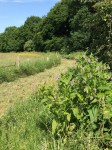
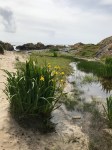
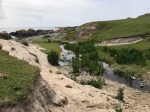
Tuesday 3 July 2018A native plant to the UK, here on the Isle of Tiree, Scotland, Iris pseudacorus (yellow iris, flag iris) is a vigorous, herbaceous perennial. It can be invasive forming extensive colonies, thriving at the margins of large ponds or streams and in moist, deep, acidic, humus-rich soil in full sun or partial shade.
Jill Raggett
Tag: jillraggett
Plant of the Day
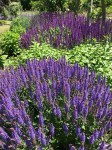
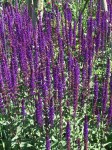
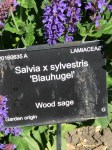
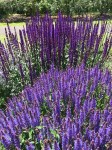
Sunday 17 June 2018The dark purple flowered Salvia nemorosa ‘Caradonna’ (Balkan clary) was working well associated with the paler flowered Salvia x sylvestris Blauhügel’ (wood sage) at the front of the rose garden borders at Cambridge Botanic Garden, UK. These herbaceous perennials make an eye-catching display for weeks in a sunny border, they are drought-tolerant once established and are popular with bees.
Jill Raggett
Plant of the Day
Tuesday 29 May 2018The National Saxifraga Collection has come into full flower and is being displayed in the Alpine House of Cambridge Botanic Gardens, UK, including the elegant plume of flowers produced by Saxifraga ‘Superba’ (Saxifraga callosa subsp. callosa var. australis).
Interestingly scientists at the Sainsbury Laboratory Cambridge University, based in the Botanic Gardens, have found that the mineral vaterite, a form of calcium carbonate, is a major component of the protective silvery-white crust that forms on the leaves of Saxifraga. This rare mineral may have the potential to provide a new material for industrial and medical applications.
Jill Raggett
Plant of the Day
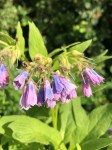
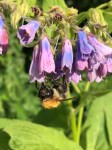
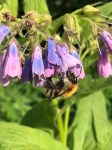
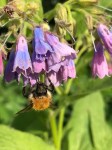
Saturday 16 June 2018The bees and others insects were keen to visit the flowers of this Symphytum officinale (common comfrey, alum, backwort, black root, blackwort, bone-set, bruisewort, healing herb, knit-back). This strong growing herbaceous perennial can be a rather invasive, but here it had competition from the grasses as it was growing on the edge of a meadow. The flowers are variable in colour on different plants from white, through pinks, to deep purple.
Jill Raggett
Plant of the Day
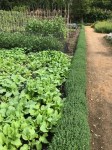
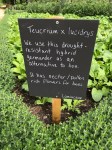
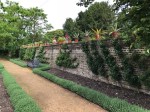
Thursday 7 June 2018With both box blight, a disease of the leaves and stems caused by the fungus Cylindrocladium buxicola, and box tree caterpillar (Cydalima perspectalis) causing problems for the health of Buxus (box) hedges here is an alternative. For the productive garden at Myddelton House, Enfield, near London, they are using Teucrium × lucidrys (hybrid germander) to edge the beds. This low-growing, woody-based evergreen perennial needs full sun and will produce clusters of small rose-pink flowers in mid to late summer which are much appreciated by the bees.
Jill Raggett
Plant of the Day
Tuesday 5 June 2018The Papaver somniferum (opium poppy) were creating some drama at the Royal Horticultural Society Chelsea Show, London, in black and white varieties. After flowering this annual forms a decorative seed capsule providing an autumn and winter display.
Jill Raggett
Plant of the Day
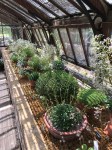
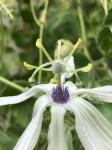
Saturday 26 May 2018In the protection of the heated glasshouse corridor at Cambridge Botanic Gardens the elegant flowers of the climber Passiflora palmeri (Passion flower) were providing a display.
Jill Raggett
Plant of the Day
Wednesday 31 May 2017
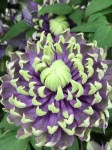
Clematis florida ‘Taiga’ (old man’s beard) has been described as a “flamboyant climber” which produces flowers throughout the summer against dark green foliage. It belongs to Clematis Pruning Group 3 where plants can be cut back to a pair of strong buds about 20cm (8”) above ground level in the spring, removing all of the previous year’s growth. This specimen was on display at the RHS Chelsea Flower Show, London.
Jill Raggett
Plant of the Day
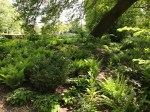
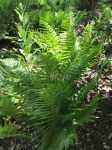
Monday 21 May 2018In this woodland garden the repeated planting of Dryopteris filix-mas (male fern, basket fern,
shield fern) provides unity to the planting design. This deciduous fern forms a shuttlecock-like whirl of fronds up to 1.2m tall. It will grow in semi-shade or full sun provided there is sufficient moisture.Jill Raggett
Plant of the Day
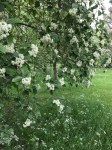
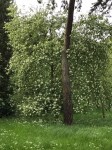
Sunday 20 May 2018The flowers of Sorbus croceocarpa (orange-berried whitebeam) create a spring display and in the autumn there will be small orange fruit. This deciduous tree species is only known as a cultivated or naturalised plant. The original place of origin of this species is not known, but it is likely to be from Europe.
Jill Raggett