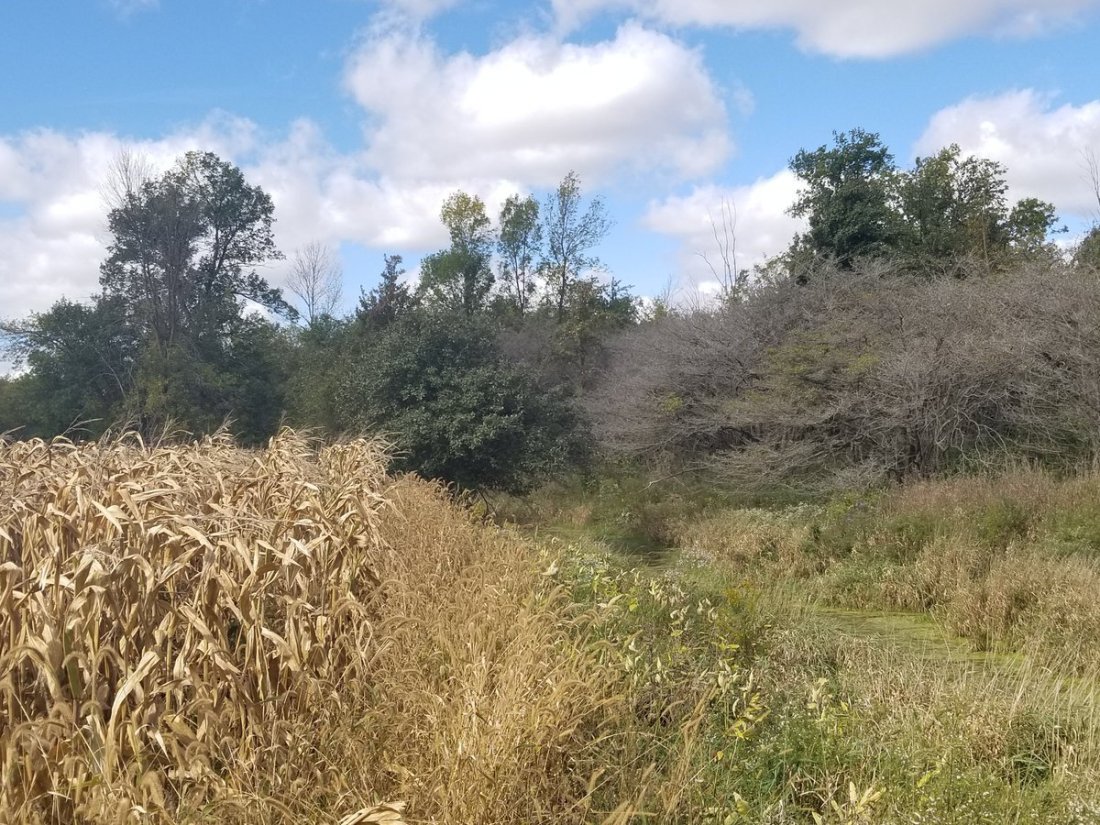
First pic I had taken from that woodland walk livetweeting (and where I chose THE WRONG SIDE OF THE CREEK).
This forest is well known for heavy poison ivy colonies (luckily encountered less than I expected) and is heavily protected by a thicket barrier of Hawthorns/Pears in the East/South side.
HOLY SH*T. THEY FOUND NITROGEN-FIXING CORN BRED BY INDIGENOUS PEOPLE IN MEXICO. @botanyshitposts
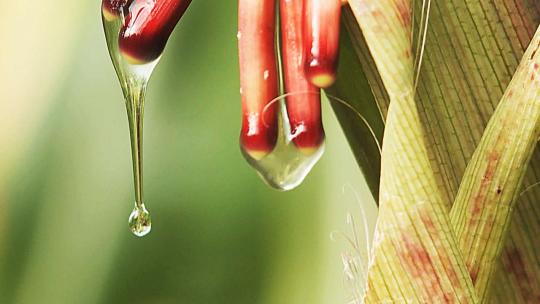
“The study found the Sierra Mixe corn obtains 28 to 82 percent of its nitrogen from the atmosphere. To do this, the corn grows a series of aerial roots. Unlike conventional corn, which has one or two groups of aerial roots near its base, the nitrogen-fixing corn develops eight to ten thick aerial roots that never touch the ground.
During certain times of the year, these roots secrete a gel-like substance, or mucilage. The mucilage provides the low-oxygen and sugar-rich environment required to attract bacteria that can transform nitrogen from the air into a form the corn can use.
“Our research has demonstrated that the mucilage found in this Sierra Mixe corn forms a key component of its nitrogen fixation,“ said co-author Jean-Michel Ané, professor of agronomy and bacteriology in the College of Agricultural and Life Sciences at UW–Madison. “We have shown this through growth of the plant both in Mexico and Wisconsin.”
…
“
Researchers are a long way from developing a similar nitrogen-fixing trait for commercial corn, but this is a first step to guide further research on that application. The discovery could lead to a reduction of fertilizer use for corn, one of the world’s major cereal crops. It takes 1 to 2 percent of the total global energy supply to produce fertilizer. The energy-intensive process is also responsible for 1 to 2 percent of global greenhouse gas emissions.
“
I’ve written about this before, this is one of those ‘saving the planet’ levels of discovery. No joke.
if you’ve been here any length of time you will recall that I’m usually the killjoy over here going “there are no silver bullets.” And this has a long way to go before it’s actually of use to farmers, but IF that happens (and that’s still a BIG IF) this would be a legit Big Fucking Deal.
Two things make me hopeful that this will not just disappear into corporate-owned varieties: one, this research was largely done through two land grant universities. Over decades. This is what land grant universities are FOR: their stated purpose is to do useful shit that’s too unprofitable for corporate R&D to care about. They are exactly the people you want developing awesome new ag tech. Mars, Inc. is involved with this too, and I trust them…not at all, but they’re not Monsanto, so it could be worse.
The other thing is this, from the linked article:
The municipal authority and community in the isolated village in the
Sierra Mixe region were an integral part of this research project.
Biological materials were accessed and utilized under an Access and
Benefit Sharing (ABS) Agreement with the community and with permission
from the Mexican government. An internationally recognized certificate
of compliance under the Nagoya Protocol has been issued for such
activities.
The ABS Agreement was structured under the terms of the Nagoya
Protocol on Access and Benefit Sharing, which is designed to ensure the
equitable sharing of benefits arising out of the utilization of genetic
resources and contributing to the conservation and sustainable use of
biodiversity.
I don’t know the details of the Nagoya Protocol. But at the very least, this isn’t outright theft of indigenous technology for corporate profit. Someone has at least thought through an equitable way for the community that developed this trait over centuries of growing maize to benefit from its use.
Finally: this is (one reason) why it’s important to preserve local crop varieties (also called landraces). Most industrialized agriculture is incredibly homogeneous genetically. It’s from the landraces that people developed slowly for specific conditions that we can find new traits–this is an extreme example, but it’s common to find landraces that are resistant to certain pests and diseases.
Oh and one more thing: Zea mays aka maize aka corn aka “indigenous Mesoamericans were better crop breeders than anyone alive today, apparently” is the WEIRDEST FUCKING PLANT, WHAT THE FUCK.


 Kihaku-Gato's Garden Blog (tumblr import)