okay so when I was a kid I was told that annuals are plants that die completely after one year/growing season while perennials include both actual always-blooming plants and the plants that may have die-off in the winter/don’t flower year round but come back the next year. But the way you used the terms in your last answer makes me think that may have been wrong? Has my mom been throwing out perfectly good petunias my whole life because they don’t flower for more than a few weeks?

botanyshitposts:

nah, she’s right!! annuals are plants that flower once and then die, effectively going through their entire life cycle in one season. perennials are plants that come back to flower each year, and just go through a dormancy period in the winter! you might notice that at greenhouses, annuals have more large, flashy and attractive flowers, while perennials have more subdued, smaller ones. perennials are usually more expensive too obs. 

in a botanical sense, the annual/perennial debate is actually more complex than that, and some species straddle the two terms (might come back, might not, eh). this can cause some friction in industrial situations where it’s important to be able to separate seed that is ‘annual’ from seed that is ‘perennial’ for the consumer! 

Definitely true that some species definitely straddle the lines of what is perennial and what is annual; Forget-Me-Not (Myosotis) are generally considered annuals, yet there are observations of species germinating one season, enduring the winter, and then flowers/seeding/dying the second growing season (a more Biannual lifecycle if you will). Conversely some Perennials like some Lupin species will live for only 3-4 years and only surviving in a location long-term purely through reseeding.

That’s also not factoring things like climates potentially changing how a plant behaves as perennial/annual; icr any species in particular, but there are cases of some plant species that live a perennial lifecycle in tropical climates while they take on a more Annual plant lifecycle in more temperate climates and surviving the next season exclusively on reseeded seedlings.

The Amorphophallus titanum in our campus greenhouse just died :'( I can’t get over it. I can’t believe how much I’m grieving for a plant

botanyshitposts:

dude no like titanums are like….another level of plant tho. like literally, they can live for 30, 40, 50+ years, blooming every decade. there’s a phenomenon ive noticed with them of individuals being dutifully cared for during that time by university greenhouse/public conservatory staff and they almost all get named. there are only roughly 300 blooms per year in the united states, and when they bloom its An Event for the location that cares for them, bringing in a ton of new visitors who aren’t that acquainted with plants for the occasion. they are more easily attached to as important creatures instead of a plant on the same level as a common houseplant, and become a fixture and an attraction in the places that tend to them. i would grieve for it, too. that’s a real loss. there are some kinds of plants that are very different in that way. 

i remember when my community greenhouse lost our century plant, a type of giant succulent that blooms once every 70-100 years right before it dies. it sends up an 11+ foot stalk with hundreds of flowers, which uses up it’s final energy reserves that it’s been building its entire life. when we lost ours it was incredible, obviously, because the stalk can go up in as little as three days- but i came in to water the greenhouses one morning and the landscaping crew had removed it’s body, leaving a gaping space in the desert bed. it had been there the entire time the greenhouse had been open. 

i turned around to water the succulents on the tables behind me, and found that the landscaping crew had saved a single one of it’s pups (an asexual offspring). it was maybe three-five inches tall, about a year old, and was sitting in a very tiny pot befitting of it’s size. they had moved the species marker from it’s mother’s space in the bed to the pot. i cried. 

those roots terrify me, ngl. At the same time, I’m amazed by their sheer height. Fear and fascination with the devil dick roots

botanyshitposts:

hot take: brace roots, where they occur, are one of the most terrifying plant organs. they just look too much like little squiggly arms seeking strength in the ground….like i think they’re weird and lovely but also im terrified

this species is called the ‘walking palm’ 

*shudders*

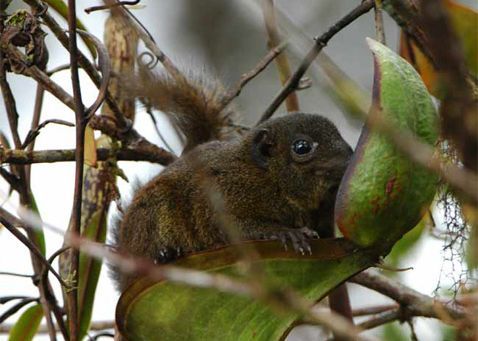
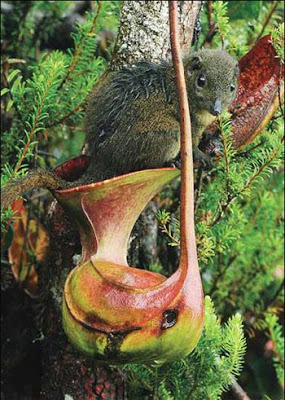
have you heard of the pitcher that uses shrew shit for food

botanyshitposts:

ah, nepenthes lowii……my old shit-eating friend…..

the mechanism- for those new to Shit Eater Mcgee over here- works like this: the pitcher top has a sweet nectar that the tree shrew native to it’s habitat loves. the shrew sits on the top of the pitcher and eats the nectar, which conveniently, though the wonders of evolution, places the shrew’s asshole directly above the neck of the pitcher. under the neck of the pitcher is digestive fluid. the shrew then poops and so is the way of life and the wonders of biology

you have no idea how much this plant is ridiculed by the scientific community. at the carnivorous plant convention i was at a couple weeks ago whenever even an IMAGE of this plant would come up on a slide it would be met with a round of laughter. nobody can take this plant seriously. 

i actually got to see it in person at the same convention, which was pretty cool, and they’re actually smaller than u would expect?? they’re notorious for taking a long time to grow their first full-sized pitchers, which makes sense when you hold one in your hands for the first time and realize that these pitchers are woody. like, i was expecting a flexible leaf kind of feel like most of the other species have, but apparently to support the sheer weight of a shitting shrew on u you gotta have like, support and stuff in there. it deadass feels like light, strong, hallow wood, while looking like a flexible leaf. 

its a fucking ridiculous plant but at the same time….my bitch made it through millions of years of evolution like that. like do u see that image? that image of a shrew taking a dump into a pitcher plant? that pitcher plant has it made

botanyshitposts:

farmoid:

botanyshitposts:

broke: human oc

woke: plant species oc 

It’s kind of a Mary Sue but my plant oc is a succulent that evolved to be symbiotic with a methanogenic bacteria and their seed pods ended up just being a big ol’ sphere full of methane floating through the clouds eventually popping to disperse large seeds down to the ground where they grow half-buried like lithops and eventually flower and produce seed pods that break off and repeat the cycle.

that is not a mary sue thats a carefully crafted fictional plant species with basis in modern botany………i love it 

dude the carnivorous plant darlingtonia has a species of symbiotic bacteria in its roots that are innately there when the plant reproduces and help it with essential metabolic functions, but the catch is that the bacteria die if they get too hot so people that cultivate it have to grow it with its roots in cold running water to keep the bacteria happy. its something directly out of a dnd campaign. a succulent species in a symbiotc relationship with a methanogenic bacteria species that makes seeds float away…..sounds just like smth evolution would make 

Im pretty sure those dandelion mutation pics are fake:/

botanyshitposts:

actually, that’s an effect called fasciation, and it’s relatively common in the world of plant mutations! it’s characterized by the accidental fusing together of tissues on the stem/organ in question, which can lead to the weird funky/siamese twin flowers you see in the post. more specifically, it happens when the hormones in a plant’s growing tip (the apical meristem, for those plant physiology nerds out there) get messed up for whatever reason and the plant gets confused on what to separate, which results in a ‘crested’ flattened/fused organ. for example in certain plant illnesses it’s directly caused by a bacterial infection; the hormones secreted by the bacteria living in the growing tip mess up the plant’s chemical signaling and cause the fusing effect. it can also happen through all sorts of stuff, including viral, chemical, fungal, and genetic causes. 

i’ve seen three plants in my life like that: two were dandelions living by the side of a parking lot at my high school, and one was a branch of a bush that my plant pathology professor brought in to show us. it was on a plant in his backyard, and it had become infected with a bacterial infection that’s known for causing it. he was pretty excited lmao 

fasciation happens like…in a SHITLOAD of plants, as long as they’re vascular (meaning not mosses, basically), which makes sense, because the mutation needs a solid stem structure to happen. here’s a fasciated palm!

and a fasciated rose! (no flowers on this one, although i think its really interesting that the plant still managed to make some thorns, if a bit tumultuously):

and of course, gotta have a saguaro cactus! apparently this one lives happily in a botanical park in phoenix, arizona. good for her, out living her best life. shown here next to a normal cactus of the same species. 

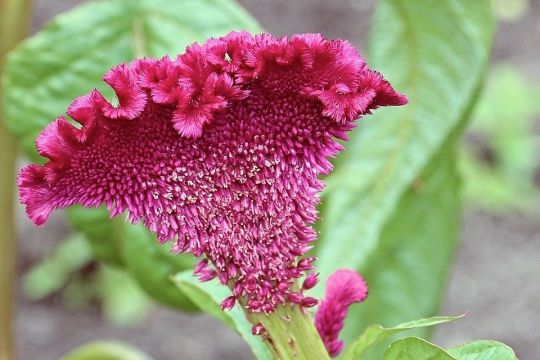
EXTRA fun fact, you may have seen THIS bad boy at ur local greenhouse, called Celosia argentea var. cristata, or ‘cockscomb celosia’ for short:

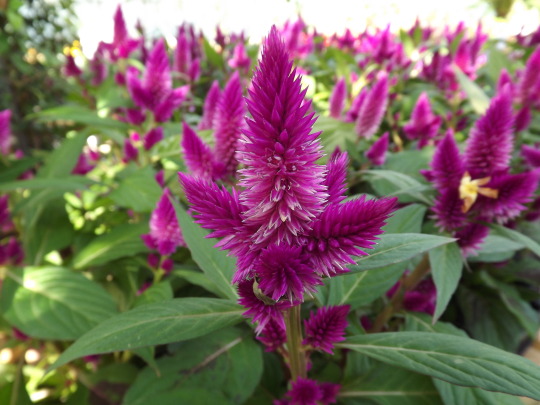
well guess what it is??? a fasciated version of Celosia argentea grown commercially specifically for its rad ass appearance!! the normal, unmutated plant looks like this:

seeing the two side by side makes it really easy to see how the plant could have messed them up just by failing to separate the flower stems right.

side note: these are not to be confused with the other variety of this plant, Celosia argentea var. plumosa, which is also popular in north american greenhouses for their funky little floofs (this pic shows a few different available colors, some of which the fasciated version are also grown in): 

so in short…. those pics are real. plants just be fucked up like that.