
THE HISTORIC 16th century GALLICA ROSE, ‘ROSA MUNDI’
Every bloom is different, and this year, there has been some reversion to the mother plant, the ‘Apothecary’s Rose’, which is all pink with golden anthers, and was found in every monastic herb garden. It is true the leaves are subject to mildew in a closed situation like our front garden but the rough foliage and tissue thin flowers of this rose are so enchanting..
Tag: ahamiltongarden
DELIGHTFUL ‘HERITAGE’ ROSE, BRED BY DAVID AUSTIN
This is a glorious myrrh scented rose with pale pink circular blooms held above dark green shiny foliage. It has ‘Iceberg’ in its ‘blood’ so it is extremely healthy, with few thorns. The roses are clustered on the ends of rather rangy stems which hang with the weight of the flowers. Our bush always grows to about one and a half metres no matter how hard I cut it back in winter. David Austin always claimed this rose to be one of the best he ever bred. I am certainly glad I chose it for our garden. In fact I wish I had planted two as it goes well with the ‘Fantin-Latour’ fence roses.
JENNY’S WONDERFUL ‘CARDINAL DE RICHELIEU’ ROSE
I have always wanted to grow this divine Gallica rose (bred c.1840). The extraordinary Old World colours of the blooms are magical to say the least. Every kind of purple coloured bruise you can think of is evident in the blooms. At all stages the flowers are so charming but I have to say I adore the unusual and individual forms and colour variations in the fully reflexed rose, and indeed also in the dying flower which reveals the delicious contrast of purple and white against big rounded leaves, those hues always a fabulous combination in the garden, in fashion, design and art. Since this is a sprawling, arching rose, I think it would be beautiful as a pillar rose, fence climber or obelisk tower. It needs lots of space if it is to grow free. It is one of the great flowers of the past that has come down to the 21st century for us to gaze upon.

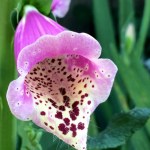







INTRIGUING DIGITALIS, OR FOXGLOVES
I could never have a garden without the biennial foxgloves. Long associated with poison and witches, they evoke the mood of medieval physic gardens and monks’ cloisters. Foxglove seedlings must be planted in summer to flower the following spring. And what a payoff it is. The regal digitalis sprires are glorious in combination with roses and other flowers. I like to have both white and pink varieties. When the main spires have finished, secondary flower shoots appear to extend the show. I usually pull the plants out and then put in their place some kind of summer or autumn flowering annual such as cosmos or zinnia. While these plants self seed in England in dappled woodland, I have not managed to achieve any free seedlings in our garden because of the mulching. As an experiment, I cut back a few of the foxglove plants instead of pulling them out last spring. I am interested to see how they perform this year compared to the newer plants. I have mentioned in another post that we also have the perennial foxglove ‘Polka Dot Polly’, which produces lovely burnt apricot spires. I will show you these when they are out as their effect in the garden is different to the stiffer biennials.

A BLACK HELLEBORE WITH EUPHORBIA BRACTS AND A GRAPE HYACINTH
These are the flowers of witches and hobgoblins. The hellebore is poisonous and the euphorbia’s milky sap is an irritant. Adore the perfect new serrated and veined leaves of the hellebore. The Swedish glass is resting on my new flower book.






GIANT BLOOMS OF POTTED JAPONICA CAMELLIA ‘BOB HOPE’
These flowers are so magnificent but I can’t bring them inside as the honeyeaters and wattle birds rely on the pollen to supplement their meagre winter diet. It doesn’t matter anyway as we can see the giant flowers from the dining room and kitchen French doors. Disbudding in summer definitely results in superior blooms. These are the size of a bread and butter plate. Red flowers do not photograph well so unfortunately you can’t appreciate the sumptuousness of these beauties.
PICKING BEURRE BOSC PEARS BEFORE THE LORIKEETS EAT THEM
We always pick our pears when the birds tell us they are ready. It takes a few weeks for them to ripen inside. As well as eating them fresh, I make pear compote with cinnamon and vanilla to have with Jalna yoghurt for breakfast. The crop is much better this year because of the rain and because I fertilised the trees last year.
THE FRONT GARDEN ON A WARM LATE NOVEMBER MORNING
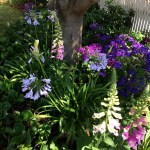
The old roses are out. ‘du Maitre d’Ecole’ is the bright pink at the back and in the foreground is Rosa Mundi, the striped beauty from the 16th century. Some of these blooms have reverted back to the pink parent plant, Rosa Versicolour. The little rose on the right that has almost finished blooming is the pale pink ‘de Meaux’, a miniature Centifolia rose from the 18th century. There is also hot pink lychnis coronaria, or rose campion, an essential perennial plant, in front of the lavender that blooms mid December.
 Kihaku-Gato's Garden Blog (tumblr import)