



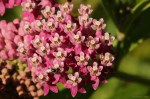
Appalachian Summer, 2018, Volume Twenty-Two: Swamp Milkweed. As the first milkweeds of summer – Asclepias syriaca and tuberosa – fade away by mid to late July, swamp milkweed (Asclepias incarnata) rises to assume their important roles within Appalachia’s summer ecosystem. A gorgeous perennial herb of wet meadows, marshes, and stream edges, swamp milkweed bears upright clusters of pink flowers at the top of a tall, branching stem, whose leaves are narrow,
lanceolate, and opposite with smooth edges. As with those of its relatives, swamp milkweed’s flowers are arranged in a “hoods and horns” structure with five downward-swooping petals surrounding a central crown of five upward-pointing horns. The petals are a light pink to deep rose shade and contrast vividly with the pinkish white to cream-colored crown. Swamp milkweed, also known as rose or pink milkweed, plays a critical role in the life-cycles of the monarch and queen butterflies, both as a food source for their caterpillars, which eat the foliage, and their adult forms, which consume the nectar from the flowers. The flowers attract a wide variety of butterflies, bees, and other insects, as well as hummingbirds. You can find a good resource here for growing milkweeds as monarch and queen butterfly host plants.
 Kihaku-Gato's Garden Blog (tumblr import)