

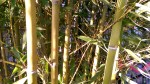

Phyllostachys sp., Poaceae
When my uncle renovated a very old property with a small plot of land on the other side of an irrigation canal, he found the overgrown garden infested with bamboo rhizomes. He eventually managed to bring it under control, and it’s now growing into a green screen separating the house and the garden, but also into a tunnel which envelops the small bridge over the water.
Judging by the groove on each segment of the stem, I identified it as a species within the Phyllostachys genus, but it’s quite hard to pinpoint the exact one from the photos I’ve taken in December. Most Phyllostachys species are native to central and southern China, but are naturalised in many other areas of the world and include some of the most widely recognised bamboos. P. edulis, for example, produces extremely fast growing edible shoots (which require preparation to remove toxins) and is the main source of fiber for the highly controversial bamboo-derived rayon textile market.
Bamboo has proved fundamental for some cultures as an abundant and fast-growing plant resource, but a garden can benefit from its presence too if measures are taken to prevent it from spreading and taking over the place. It can be used to create narrow, dense windbreak screens to protect less hardy plants from cold winds. It continuously produces building and crafting material with great physical properties and it can even be shaped as it grows to assume the section or profile required, with dramatically quicker results than in normal tree shaping. The stems can also be burnt to create a very absorbent charcoal useful as a soil amendment and the bio-mass not needed can be composted: it might take a while, but the process is much faster if the stems are first crushed or shredded. Lastly, we can’t ignore the ornamental value of a bamboo thicket, with its feathery silhouette and airy appearance often associated with bright hues of green and yellow and straight or angled internodes.
 Kihaku-Gato's Garden Blog (tumblr import)