
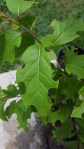

Leafcutter bee (Megachile sp.) damage on American persimmon (Diospyros virginiana). It can be differentiated from other insect damage by the neatly cut edges and the fact that it is generally confined to the outer edge of the leaf, with no signs of droppings, webbing, molted skins or larvae. Leafcutter ants also make cuts, but they will usually be present and observable until the plant is defoliated.
Although the damage may be unsightly, leafcutter bees do not take enough leaf tissue to harm the host plant. They use the bits of leaf to line the individual cells of their nests. This may serve to keep the cells and the food supply in them from drying out.
Megachile often preferentially target certain plants; despite having a wide variety of plants to choose from in our yard, they’ve only cut from this persimmon so far. That’s fine with me, because it means we have an actively reproducing population! I’m curious to see what other plants they might choose, as some studies I’ve read have found they have a strong preference for plants in the rosid clade (persimmons are in the asterid clade, which was the second most favored). The large number of non-native plants around might skew the preferences of the local population, so I guess we’ll just keep our eyes open.
 Kihaku-Gato's Garden Blog (tumblr import)